





Kazalbash v Secretary of State for Levelling Up, Housing and Communities and the London Borough of Hillingdon Council
In 2021 planning permission for the subdivision of a semi-detached dwelling house in a residential street in the London suburb of Northwood was dismissed by a planning inspector as it would harm the character and appearance of the area. The appeal judge in the high court considered that this conclusion was irrational and allowed the development, quashing the decision and granting planning permission in 2022.
The court of appeal has now concluded that the planning inspector’s decision had been logical, coherent, properly reasoned, and sufficient to discharge his statutory obligations in relation to s70 of the Town and Country Planning Act 1990 and s38(6) of the Planning and Compensation Act 2004 (Kazalbash v Secretary of State for Levelling Up, Housing and Communities and the London Borough of Hillingdon Council [2023] EWCA Civ 904).
In coming to this conclusion, the court of appeal judge considered that the planning inspector had assessed the scheme against the relevant local plan policies with reference to the prevailing pattern of development in the area. This included strong building lines, consistent setback from the road, and similar plot sizes and widths, creating a pleasant rhythm in the street scene which contributed positively to the character and appearance of the area. There would be no change to the external fabric of the building; a new house would be created by dividing the rear garden into two with a fence, and using the existing side extension as a separate house. The inspector had noted that while the setback of the extension may have helped it to appear subservient when constructed as an extension, as a separate dwelling it would appear incongruous, harming the character and appearance of the area. The judge in the court of appeal stated that the inspector’s decision could not be faulted in law and was legally impeccable, and the appeal was allowed.
Although this site was not in a conservation area, the court of appeal judge analysed the application of the phrase ‘character and appearance of the area’. He stated that ‘the task the inspector set himself was to exercise his own planning judgement in assessing “the effect of the proposal on the character and appearance of the area”.’ The judge stated that the inspector was not using this expression as if it equated to the statutory concept of ‘character or appearance’ in the Planning (Listed Buildings and Conservation Areas) Act 1990.
This article originally appeared as ‘The secretary of state disagrees’ in the Institute of Historic Building Conservation’s (IHBC’s) Context 178, published in December 2023. It was written by Alexandra Fairclough, conservation officer for Cheshire East, a lecturer and a member of the IHBC legal panel. A former planning inspector, she was called to the bar in 2009, and before that was IHBC law and practice coordinator.
--Institute of Historic Building Conservation
Related articles on Designing Buildings
IHBC NewsBlog
How could the City of London skyline look in 6 years' time?

Visualisation shows approved planning applications as completed buildings
National Trust for Scotland calls for VAT cuts
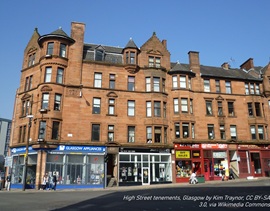
Heritage neglect is encouraged by current policies
IHBC's 'Context' Issue 186 features Industrial Heritage

IHBC's members' journal reports on the challenges of conserving infrastructure.
Book now for IHBC Annual School 2026
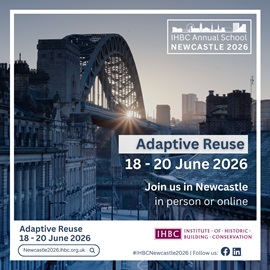
IHBC Annual School is taking place 18-20 June 2026 in Newcastle.
RICHeS Research Infrastructure offers ‘Full Access Fund Call’

RICHeS offers a ‘Help’ webinar on 11 March
Latest IHBC Issue of Context features Roofing
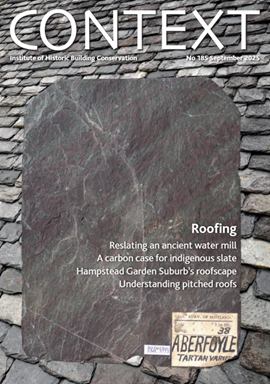
Articles range from slate to pitched roofs, and carbon impact to solar generation to roofscapes.
Three reasons not to demolish Edinburgh’s Argyle House

Should 'Edinburgh's ugliest building' be saved?
IHBC’s 2025 Parliamentary Briefing...from Crafts in Crisis to Rubbish Retrofit
IHBC launches research-led ‘5 Commitments to Help Heritage Skills in Conservation’
How RDSAP 10.2 impacts EPC assessments in traditional buildings

Energy performance certificates (EPCs) tell us how energy efficient our buildings are, but the way these certificates are generated has changed.
700-year-old church tower suspended 45ft

The London church is part of a 'never seen before feat of engineering'.